
Youth-Led Exam Leak Protests Signal Political Shift in India, Says Activist Sonam Wangchuk
Following a 26-day hunger strike, the climate and education reformer says public dissent has shaken PM Modi's government.
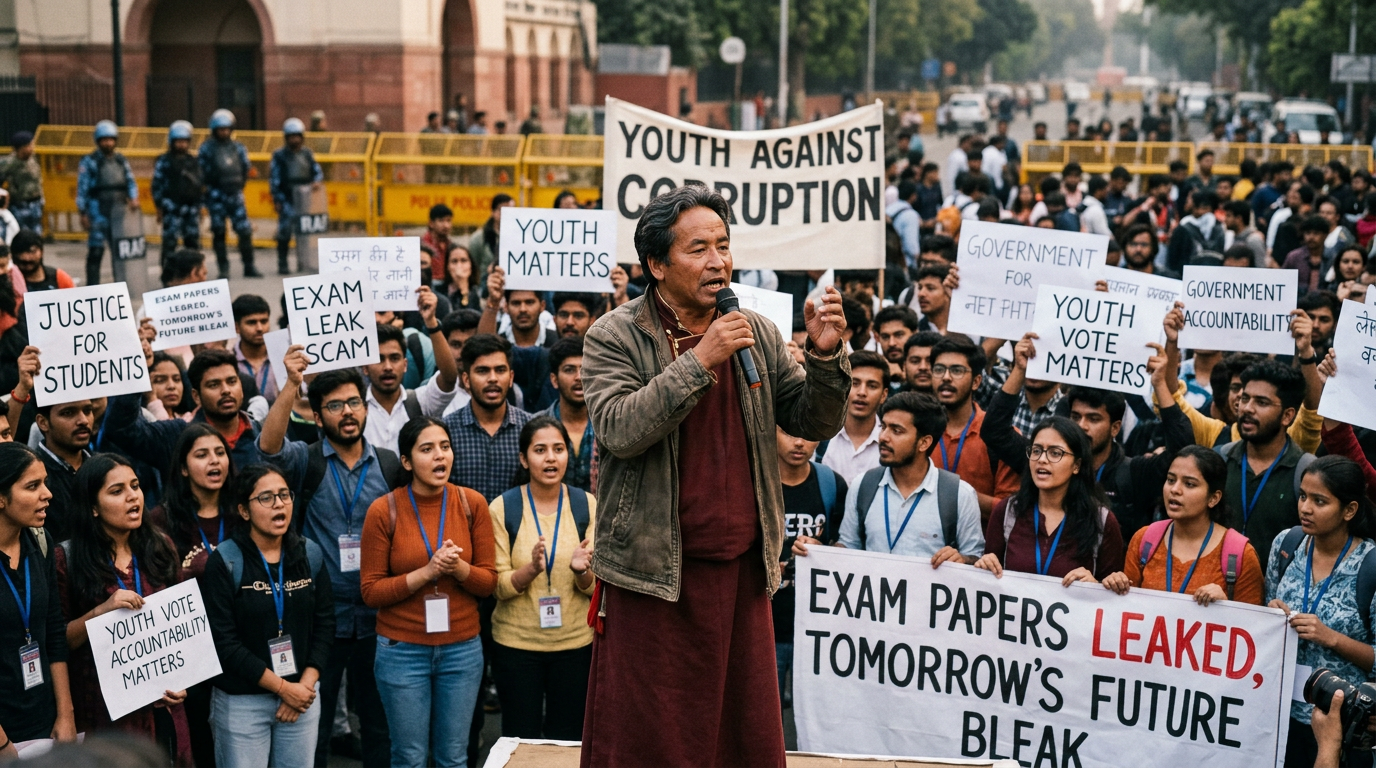
Prominent Indian education activist Sonam Wangchuk stated that widespread youth protests over examination paper leaks have severely weakened Prime Minister Narendra Modi's administration. Following a 26-day hunger strike that fueled nationwide dissent, Wangchuk highlighted how young citizens have gained renewed confidence in holding the government accountable.
Main Story
Renowned engineer and education reformer Sonam Wangchuk revealed that recent youth demonstrations have fundamentally altered India's political atmosphere. Speaking after ending a nearly month-long hunger strike in New Delhi, the 59-year-old activist noted that young citizens now recognize their capacity to drive significant national policy changes rather than accepting systemic failures quietly.
Wangchuk's 26-day fast, during which he consumed only salt and water in extreme heat, served as a focal point for rising student frustration. During the final six days of his strike, authorities forcibly transferred Wangchuk to hospital facilities that he described as functioning like detention centers. The fast concluded shortly before Education Minister Dharmendra Pradhan resigned on July 25, marking a major political concession by the governing administration.
The movement, informally dubbed the "Cockroach" movement, mobilized thousands of students across the country. According to Wangchuk, the political fallout has already affected the ruling Bharatiya Janata Party (BJP), pointing to its recent losses in two out of three state by-elections, including a constituency in Bihar state held by the party for more than three decades.
Background
The public outrage originally stems from high-profile leaks of national examination papers, which disrupted the career prospects of millions of students. Protesters adopted the label "Cockroach movement" after India's Chief Justice drew severe public backlash for comparing groups of unemployed young people to cockroaches during a judicial hearing.
The crisis highlights deep-seated economic issues in India, where graduate unemployment has hovered between 35% and 40% for the past quarter-century. Wangchuk argued that the current examination framework relies heavily on standardized multiple-choice testing, prioritizing administrative efficiency over practical competence and critical thinking.
"There needs to be some planning of what the world and the country are likely to look like in 15 years," Wangchuk said, urging a shift toward hands-on learning and skill assessment to align education with labor market demands.
While the Indian government maintains that its macroeconomic foundations remain robust and claims regarding an employment crisis are exaggerated, the scale of student dissatisfaction has forced official course corrections.
Timeline
- June–July: Sonam Wangchuk conducts a 26-day hunger strike in New Delhi to highlight systemic flaws in education and job security.
- July 24: Wangchuk breaks his fast after spending his final days under forced medical observation.
- July 25: Education Minister Dharmendra Pradhan steps down amid intensifying nationwide demonstrations.
- Late July: Prime Minister Narendra Modi announces reform measures, including fast-track courts for exam fraud and compensation for families of impacted students.
Key Facts
- Movement Origin: Named the "Cockroach" movement following a controversial comparison made by India's Chief Justice.
- Structural Unemployment: Indian graduate unemployment has remained near 35% to 40% over the last 25 years.
- Government Measures: Establishment of special fast-track courts for leak inquiries and appointment of a tech executive to restructure national testing.
- Activist Stance: Sonam Wangchuk advocates non-violent resistance inspired by Mahatma Gandhi and disavows political candidacy.
Latest Developments
In response to the escalating crisis, Prime Minister Modi announced several remedial measures, including the creation of fast-track courts to try individuals implicated in exam paper leaks. The administration also appointed a prominent technology entrepreneur to oversee testing system overhauls and offered financial relief to families of students who tragically took their lives following the leak scandals.
Despite these governmental gestures, many participating students face ongoing repercussions. Reports indicate that several demonstrators affiliated with the Cockroach Janta Party continue to experience police harassment, court summonses, and online intimidation, even after the Supreme Court prohibited coercive action against protesters lacking prior criminal records.
What's Next
Wangchuk warned that if the government fails to address core economic and educational grievances, future public demonstrations could expand beyond student welfare into broader political dissent. Returning to his home region of Leh in Ladakh, Wangchuk reaffirmed his commitment to non-violent agitation, emphasizing that peaceful resistance forces governmental introspection far more effectively than violent confrontations.
FAQ
Q: What triggered the widespread youth protests in India? A: The demonstrations erupted following recurring leaks of national examination papers, compounding frustration over long-term graduate unemployment.
Q: What concessions did the Indian government make? A: The government accepted the resignation of the Education Minister, set up fast-track courts for exam leak prosecutions, initiated examination system reforms, and offered compensation to affected families.
Conclusion
The youth-led movement led by Sonam Wangchuk marks a pivotal moment in contemporary Indian politics, demonstrating the power of peaceful civil resistance against established authority. As the governing coalition faces upcoming electoral challenges, structural educational reform and job creation remain critical to restoring public trust among the nation's vast youth demographic.